
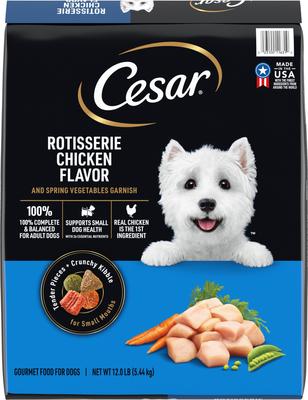
Rotisserie Chicken Flavor & Spring Vegetables Garnish Small Breed Dry Dog Food, 12-lb bag
Cesar Rotisserie Chicken Flavor & Spring Vegetables Garnish Small Breed Dry Dog Food, 12-lb bag earns a Sniff Score of 3/100 (F) with Fair evidence. 5 controversial ingredients flagged. Score capped at 39 due to 5 FLAG ingredients.
Graded by The Sniff System
Quality carbohydrate sources with fermentable fiber.
Controversial ingredients · 6
- bhaSynthetic preservative classified by the U.S. National Toxicology Program as 'reasonably anticipated to be a human carcinogen.' Many premium brands have removed it.
- yellow 6Artificial color with no nutritional value.
- red 40Artificial color with no nutritional value. Linked to behavioral effects in children; relevance to dogs is unclear but the ingredient serves only marketing purposes.
- yellow 5Artificial color with no nutritional value. Some dogs show allergic-type reactions.
- sodium seleniteSynthetic selenium source. Selenium is essential, but sodium selenite has a narrower safety margin than organic alternatives like selenium yeast. Better-formulated foods use the organic form.
- blue 2Artificial color. A 1990s industry-funded study reported brain tumors in male rats; subsequent reviews disputed methodology, but the additive provides no nutritional benefit.
Every flagged ingredient has a published basis (confirmed harm / regulatory action / precautionary). See methodology →
Read why each ingredient is good or bad for dogs.
- 1protein animalchicken
Real meat. Primary protein source, with the amino acid profile dogs actually evolved to eat.
- 2grainwhole grain corn
Whole corn with the kernel intact. Decent fiber and B vitamins, though it can crowd out meat in cheaper recipes.
- 3grainground wheat
Whole wheat. Fine for most dogs, though a portion are sensitive. Not a quality concern, just a fit-for-your-dog question.
- 4meat and bone meal
Unnamed animal protein with bone included. Cheap, vague, and not traceable to a specific species.
- 5brewers rice
Broken rice kernels left over from milling, usually destined for human beer-making. Cheaper than whole or even white rice. Same carbs, less nutrition than the brown version.
- 6protein animalchicken by-product meal
Ground organs, bone, and tissue. Nutritionally dense, especially the liver and gizzard fractions. Named species ('chicken') is what matters. Generic 'poultry by-product meal' is the one to worry about.
- 7animal fat
Unnamed fat source. The species matters: 'chicken fat' or 'beef fat' is fine, but 'animal fat' tells you nothing about origin.
- 7preservative syntheticbha Flagged
Synthetic preservative. Listed as a possible human carcinogen by the IARC. Banned from human food in Japan and parts of the EU, still permitted in US pet food.
- 8protein plantsoybean meal
Concentrated soy protein. Cheap plant protein that pads the label number, common in budget formulas.
- 9protein plantcorn gluten meal
Concentrated corn protein. Inflates the protein percent on the label without matching meat-quality amino acids.
- 10othernatural flavor
Legal term for animal-derived flavoring, usually hydrolyzed liver or broth. Adds taste, says nothing about quality.
- 11dried plain beet pulp
Beet fiber, with the sugar removed. Long unfairly maligned. It's a real soluble fiber that supports stool quality.
- 12protein animalchicken meal
Chicken with the water cooked out. Per pound, packs more protein than fresh chicken.
- 13glycerin
Humectant used in soft-moist foods to keep them chewy. Safe in moderation but a signal of a processed semi-moist product.
- 14mineralsalt
Sodium chloride. Required at small doses for normal physiology. Not a quality concern in standard amounts.
- 15water
Just water. Counted on the label of any wet or fresh food. The number tells you the moisture content.
- 16sugar
Added sugar. No nutritional purpose for dogs. Most often found in budget semi-moist foods.
- 17potassium sorbate
- 18phosphoric acid
- 19mineralpotassium chloride
Required mineral. Sometimes used as a salt substitute. Standard inclusion in complete diets.
- 20natural rotisserie chicken flavor
- 21dried peas
Cheap protein bulk. Fine in small amounts, but when peas stack with lentils and chickpeas in the top ingredients, it's the pattern the FDA flagged in its heart-disease investigation. See why →
- 22mineralcalcium carbonate
Source of calcium. Functional. Required in complete dog foods, especially those without bone-in meat meals.
- 23supplementcholine chloride
Essential nutrient for liver and brain function. Standard inclusion in complete dog foods.
- 24supplementdl-methionine
Essential amino acid. Often added when plant proteins dominate, since methionine is naturally lower in pulses than meat.
Showing first 25 of 45. Position 1-5 has the largest weight in the recipe.
22 of 25 ingredients have a curated note. Coverage grows over time.