
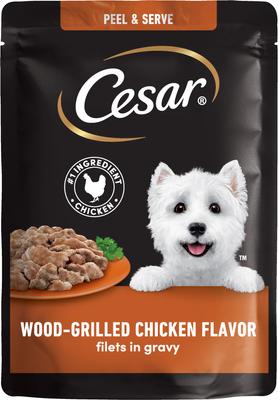
Wood-Grilled Chicken Flavor Filets in Gravy Wet Dog Food, 1.76-oz pouch, case of 20
Cesar Wood-Grilled Chicken Flavor Filets in Gravy Wet Dog Food, 1.76-oz pouch, case of 20 earns a Sniff Score of 48/100 (C) with Fair evidence. 1 controversial ingredient flagged. Score capped at 59 due to no AAFCO statement.
Graded by The Sniff System
Reasonable protein quality. chicken delivers solid amino acid coverage.
Includes egg, named fish, or organ meat for diverse high-bioavailability protein.
No declared omega-3 source. Fish oil, salmon oil, and algae oil all absent.
No AAFCO statement. Nutritional completeness unverified.
Wet and fresh foods contain more water than kibble (typically 65-78%). On a dry-matter basis, this food's protein content is roughly 44%, comparable to premium kibble (typically 30-45% DMB protein).
Read why each ingredient is good or bad for dogs.
- 1protein animalchicken
Real meat. Primary protein source, with the amino acid profile dogs actually evolved to eat.
- 2chicken broth
Real broth, adds flavor and moisture. Negligible nutrition on its own but tells you the recipe leans on real meat.
- 3water
Just water. Counted on the label of any wet or fresh food. The number tells you the moisture content.
- 4protein animalchicken liver
Organ meat. Dense in protein, iron, vitamin A, and the B vitamins. Among the most nutrient-rich ingredients a dog can eat.
- 5dried egg product
Whole eggs with the water removed. Same nutritional value as fresh eggs, just shelf-stable.
- 6protein plantwheat gluten
Concentrated wheat protein. Like other plant gluten meals, it pads the protein number on the label without contributing meat-quality amino acids.
- 7tapioca starch
Refined cassava starch, used as a binder. Easy to digest, low on nutrition.
- 8wheat flour
Refined wheat, usually used as a binder. Cheap, not harmful, not a nutrition contributor.
- 9mineralsalt
Sodium chloride. Required at small doses for normal physiology. Not a quality concern in standard amounts.
- 10dried plain beet fiber
- 11mineralmagnesium sulfate
Source of magnesium, a required mineral. Standard inclusion in complete diets.
- 12mineralpotassium chloride
Required mineral. Sometimes used as a salt substitute. Standard inclusion in complete diets.
- 13mineralcalcium carbonate
Source of calcium. Functional. Required in complete dog foods, especially those without bone-in meat meals.
- 14mineraltricalcium phosphate
Calcium and phosphorus source. Same role as dicalcium phosphate, slightly different ratio.
- 15mineralsodium tripolyphosphate
Preservative and texture agent in wet food. Functional at small doses, not a major concern, but some brands avoid it.
- 16fiberxanthan gum
Thickener common in wet food and gravies. Same emulsifier-microbiome conversation as guar gum, not a clear flag.
- 17supplementcholine chloride
Essential nutrient for liver and brain function. Standard inclusion in complete dog foods.
- 18wood grilled chicken flavor
- 19added color
Generic coloring. Doesn't say if natural or artificial. Dogs are color-blind, so any added color is for the human shopper.
- 20mineralzinc sulfate
Inorganic zinc. Effective at AAFCO doses but less well-absorbed than chelated forms like zinc proteinate.
- 21vitaminvitamin e supplement
Required nutrient and a natural antioxidant. Often pulls double duty as a preservative.
- 22vitaminniacin supplement
B vitamin (B3). Required in complete dog foods, added as a supplement to standardize the dose.
- 23vitaminpyridoxine hydrochloride
B vitamin (B6). Essential for protein metabolism. Standard inclusion in complete formulas.
- 24vitaminthiamine mononitrate
B vitamin (B1). Essential for nervous system function. Cooked-in vitamin loss is why thiamine is always added back.
- 25vitaminvitamin a supplement
Vitamin A in stable, standardized form. Required for vision, immune function, and growth.
Showing first 25 of 34. Position 1-5 has the largest weight in the recipe.
23 of 25 ingredients have a curated note. Coverage grows over time.