
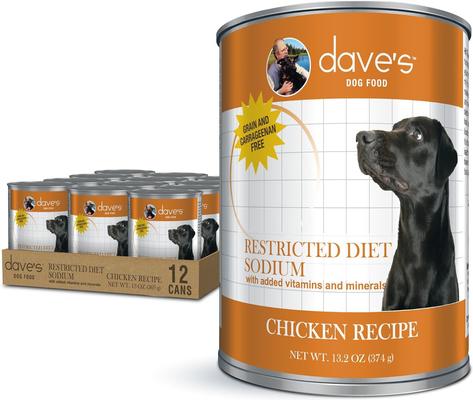
Restricted Sodium Chicken Recipe Grain-Free Wet Dog Food, 13.2-oz can, 12 count
Dave's Pet Food Restricted Sodium Chicken Recipe Grain-Free Wet Dog Food, 13.2-oz can, 12 count earns a Sniff Score of 36/100 (D) with Fair evidence. 1 controversial ingredient flagged. Score capped at 59 due to no AAFCO statement.
Graded by The Sniff System
Low protein quality. chicken delivers limited bioavailable amino acids.
No declared omega-3 source. Fish oil, salmon oil, and algae oil all absent.
Controversial ingredients · 1
- sodium seleniteSynthetic selenium source. Selenium is essential, but sodium selenite has a narrower safety margin than organic alternatives like selenium yeast. Better-formulated foods use the organic form.
Every flagged ingredient has a published basis (confirmed harm / regulatory action / precautionary). See methodology →
Wet and fresh foods contain more water than kibble (typically 65-78%). On a dry-matter basis, this food's protein content is roughly 39%, comparable to premium kibble (typically 30-45% DMB protein).
Read why each ingredient is good or bad for dogs.
- 1protein animalchicken
Real meat. Primary protein source, with the amino acid profile dogs actually evolved to eat.
- 2water sufficient for processing
The regulatory phrase for cooking water in wet food. Has no nutritional implication, just labeling formality.
- 3fiberguar gum
Thickener common in wet food. Emerging research on emulsifiers and the gut microbiome, but no smoking gun in dogs yet.
- 4agar-agar
Seaweed-derived gel used as a thickener. Functional alternative to carrageenan, generally well-tolerated.
- 5zinc amino acid chelate
Zinc bound to amino acids for better absorption. Same idea as zinc proteinate, the premium form of the mineral.
- 6iron amino acid chelate
Iron bound to amino acids for better absorption. Premium form versus inorganic iron sulfate.
- 7copper amino acid chelate
Copper bound to amino acids for better absorption. Premium form versus copper sulfate.
- 8manganese amino acid chelate
Manganese bound to amino acids for better absorption. The chelated form most premium brands use.
- 9mineralsodium selenite Flagged
Inorganic selenium. Effective at AAFCO levels, no documented safety concern in dogs despite what some pet food blogs claim. Selenium yeast is a marginal upgrade, not a necessity. See why →
- 10cobalt amino acid chelate
Cobalt bound to amino acids for better absorption. Trace mineral needed for B12 synthesis.
- 11mineralpotassium iodide
Source of iodine, an essential trace mineral for thyroid function. Required for AAFCO-complete formulas.
- 12vitaminvitamin e supplement
Required nutrient and a natural antioxidant. Often pulls double duty as a preservative.
- 13vitaminthiamine mononitrate
B vitamin (B1). Essential for nervous system function. Cooked-in vitamin loss is why thiamine is always added back.
- 14vitaminniacin supplement
B vitamin (B3). Required in complete dog foods, added as a supplement to standardize the dose.
- 15vitamind-calcium pantothenate
B vitamin (B5). Standard inclusion in complete dog foods.
- 16vitaminvitamin a supplement
Vitamin A in stable, standardized form. Required for vision, immune function, and growth.
- 17vitaminriboflavin supplement
B vitamin (B2). Required in complete dog foods. The standardized form ensures consistent dosing.
- 18vitaminbiotin
B vitamin that supports skin and coat health. Required for AAFCO-complete formulas.
- 19vitaminvitamin b12 supplement
Essential for red blood cell formation and neurological function. Plant ingredients lack B12, so it has to be added.
- 20vitaminpyridoxine hydrochloride
B vitamin (B6). Essential for protein metabolism. Standard inclusion in complete formulas.
- 21vitaminvitamin d3 supplement
The active form of vitamin D dogs need. Required for calcium absorption and bone health.
- 22vitaminfolic acid
B vitamin (B9), essential for cell function. Standard in complete dog foods.
- 23sodium carbonate
pH buffer used in food processing. Functional, no quality signal.
23 of 23 ingredients have a curated note. Coverage grows over time.