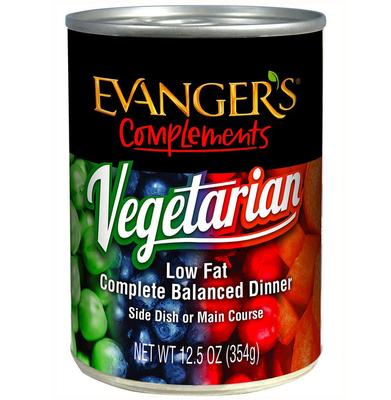
Low Fat Vegetarian Dinner Canned Dog & Cat Food, 12.8-oz, case of 12
Evanger's Low Fat Vegetarian Dinner Canned Dog & Cat Food, 12.8-oz, case of 12 earns a Sniff Score of 33/100 (D) with Fair evidence. Zero controversial ingredients flagged. Score capped at 59 due to no AAFCO statement.
Graded by The Sniff System
Quality carbohydrate sources with declared fiber.
Plant-protein-dominated formula. sweet potato as the #1 ingredient.
No declared omega-3 source. Fish oil, salmon oil, and algae oil all absent.
Controversial ingredients · 1
- sodium seleniteSynthetic selenium source. Selenium is essential, but sodium selenite has a narrower safety margin than organic alternatives like selenium yeast. Better-formulated foods use the organic form.
Every flagged ingredient has a published basis (confirmed harm / regulatory action / precautionary). See methodology →
Wet and fresh foods contain more water than kibble (typically 65-78%). On a dry-matter basis, this food's protein content is roughly 29%, comparable to premium kibble (typically 30-45% DMB protein).
Read why each ingredient is good or bad for dogs.
- 1vegetablesweet potato
Complex carb with fiber and beta-carotene. Gentle on the stomach.
- 2vegetablepotato
Standard white potato. Steady carb source, common starch in grain-free recipes.
- 3water sufficient for processing
The regulatory phrase for cooking water in wet food. Has no nutritional implication, just labeling formality.
- 4grainbrown rice
Whole grain that's easy to digest. Steady carb energy plus a little fiber.
- 5vegetablecarrots
Real vegetable. Fiber, beta-carotene, and a small amount of antioxidant value.
- 6tomatoes
Real fruit. Lycopene and trace antioxidants. Different from tomato pomace, which is the fiber byproduct.
- 7olive oil
- 8legumepeas
Cheap protein bulk. Fine in small amounts, but when peas stack with lentils and chickpeas in the top ingredients, it's the pattern the FDA flagged in its heart-disease investigation. See why →
- 9fruitblueberries
Antioxidants, real. But the amount in any kibble is too small to do much. Mostly marketing.
- 10fruitcranberries
Often added with a urinary-tract-support marketing angle. Real cranberry compounds help in concentrate form, but kibble doses are small.
- 11dried eggs
Whole eggs. The highest-quality protein on any ingredient label by amino acid score.
- 12dried brewers yeast
- 13vegetable oil
Unnamed plant oil. Could be soy, canola, corn, or a blend. Named oils like sunflower or canola are more transparent.
- 14supplementtaurine
Amino acid critical for heart health. Especially important in grain-free or pulse-heavy formulas where natural taurine precursors run thin.
- 15mineraldicalcium phosphate
Calcium and phosphorus combined. Required source of both minerals, especially in formulas without much bone content.
- 16mineralpotassium chloride
Required mineral. Sometimes used as a salt substitute. Standard inclusion in complete diets.
- 17mineralcalcium carbonate
Source of calcium. Functional. Required in complete dog foods, especially those without bone-in meat meals.
- 18mineralzinc sulfate
Inorganic zinc. Effective at AAFCO doses but less well-absorbed than chelated forms like zinc proteinate.
- 19mineralferrous sulfate
Inorganic iron. Standard mineral source. Iron proteinate is the gentler, better-absorbed premium form.
- 20vitaminvitamin e supplement
Required nutrient and a natural antioxidant. Often pulls double duty as a preservative.
- 21mineralzinc proteinate
Zinc bound to protein for better absorption. The premium form of the mineral, versus zinc oxide which sits cheaper on the label.
- 22vitaminniacin supplement
B vitamin (B3). Required in complete dog foods, added as a supplement to standardize the dose.
- 23l-ascorbyl-2-polyphosphate
A stable form of vitamin C used in pet food. Provides antioxidant support and survives processing better than plain ascorbic acid.
- 24mineralcopper sulfate
Inorganic copper. Standard, effective at small doses. Premium formulas tend to use copper proteinate instead.
- 25mineralmanganese sulfate
Inorganic manganese. Functional but less well-absorbed than the chelated proteinate form.
Showing first 25 of 38. Position 1-5 has the largest weight in the recipe.
23 of 25 ingredients have a curated note. Coverage grows over time.