
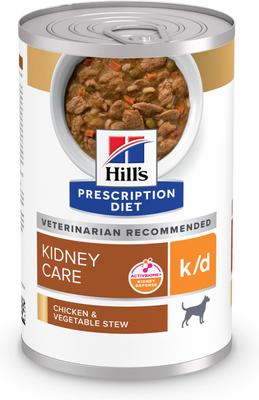
k/d Kidney Care Chicken & Vegetable Stew Wet Dog Food, 12.5-oz can, case of 12
Hill's Prescription Diet k/d Kidney Care Chicken & Vegetable Stew Wet Dog Food, 12.5-oz can, case of 12 earns a Sniff Score of 49/100 (C) with Fair evidence. 2 controversial ingredients flagged. Score capped at 49 due to CP_DM=11.8%, CF_DM=20.6%.
Graded by The Sniff System
Reasonable protein quality. chicken delivers solid amino acid coverage.
Quality fat sources: named fat with marine oil (EPA and DHA source).
AAFCO feeding trial substantiation for not stated.
Contains guar gum. Emerging microbiome data on emulsifiers; no canine clinical evidence. Minor penalty in canned food..
Contains added sugar. Nutritionally unjustifiable in any complete dog diet..
Controversial ingredients · 1
- sodium seleniteSynthetic selenium source. Selenium is essential, but sodium selenite has a narrower safety margin than organic alternatives like selenium yeast. Better-formulated foods use the organic form.
Every flagged ingredient has a published basis (confirmed harm / regulatory action / precautionary). See methodology →
Wet and fresh foods contain more water than kibble (typically 65-78%). On a dry-matter basis, this food's protein content is roughly 12%, comparable to premium kibble (typically 30-45% DMB protein).
Read why each ingredient is good or bad for dogs.
- 1water
Just water. Counted on the label of any wet or fresh food. The number tells you the moisture content.
- 2protein animalchicken
Real meat. Primary protein source, with the amino acid profile dogs actually evolved to eat.
- 3vegetablecarrots
Real vegetable. Fiber, beta-carotene, and a small amount of antioxidant value.
- 4grainrice
Generic rice. Could be white or brown, the label doesn't say. Brown rice would be specified if it were.
- 5fatchicken fat
Despite the name, a high-quality energy source. Concentrated calories plus essential fatty acids like linoleic acid.
- 6protein animalpork liver
Organ meat. Dense in B vitamins, iron, and vitamin A. Among the most nutritious ingredients on any label.
- 7rice starch
- 8dextrose
- 9legumegreen peas
Same as peas. Useful in small amounts. The concern is when pulses dominate the top of the ingredient list. See why →
- 10sugar
Added sugar. No nutritional purpose for dogs. Most often found in budget semi-moist foods.
- 11egg whites
- 12fiberdried beet pulp
Soluble fiber from sugar-beet processing. Sometimes treated as a filler, but it's actually one of the better fiber sources in kibble.
- 13fatflaxseed
Plant source of omega-3. Helpful for skin and coat, though dogs absorb omega-3 from fish more efficiently.
- 14fatfish oil
Concentrated omega-3s. The reason 'EPA' and 'DHA' get to show up on the bag.
- 15hydrolyzed chicken flavor
Hydrolyzed chicken used as a palatability enhancer. Real ingredient, tiny inclusion, no quality signal either way.
- 16potassium alginate
- 17fiberpowdered cellulose
Plant fiber, often from wood pulp. Cheap bulk filler. Not harmful, but a tell that the recipe is reaching for inexpensive bulk.
- 18calcium lactate
Calcium source from lactic acid fermentation. Functional, well-tolerated.
- 19calcium gluconate
- 20othernatural flavor
Legal term for animal-derived flavoring, usually hydrolyzed liver or broth. Adds taste, says nothing about quality.
- 21brewers dried yeast
Yeast left over from brewing. Rich in B vitamins and amino acids. A traditional and well-tolerated inclusion.
- 22potassium citrate
Source of potassium. Sometimes added in urinary-support formulas to help manage urine pH.
- 23fiberguar gum
Thickener common in wet food. Emerging research on emulsifiers and the gut microbiome, but no smoking gun in dogs yet.
- 24betaine
- 25supplementl-lysine
Essential amino acid. Plant-protein-heavy formulas sometimes add it to round out the amino acid profile.
Showing first 25 of 45. Position 1-5 has the largest weight in the recipe.
19 of 25 ingredients have a curated note. Coverage grows over time.