
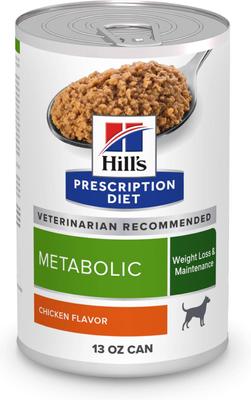
Metabolic Chicken Flavor Wet Dog Food, 13-oz, case of 12
Hill's Prescription Diet Metabolic Chicken Flavor Wet Dog Food, 13-oz, case of 12 earns a Sniff Score of 49/100 (C) with Limited evidence. Zero controversial ingredients flagged. Score capped at 49 due to CP_DM=6.7%, CF_DM=2.8%.
Graded by The Sniff System
Reasonable protein quality. pork liver delivers solid amino acid coverage.
AAFCO feeding trial substantiation for not stated.
Includes egg, named fish, or organ meat for diverse high-bioavailability protein.
Read why each ingredient is good or bad for dogs.
- 1water
Just water. Counted on the label of any wet or fresh food. The number tells you the moisture content.
- 2protein animalpork liver
Organ meat. Dense in B vitamins, iron, and vitamin A. Among the most nutritious ingredients on any label.
- 3grainwhole grain corn
Whole corn with the kernel intact. Decent fiber and B vitamins, though it can crowd out meat in cheaper recipes.
- 4protein animalchicken
Real meat. Primary protein source, with the amino acid profile dogs actually evolved to eat.
- 5fiberpowdered cellulose
Plant fiber, often from wood pulp. Cheap bulk filler. Not harmful, but a tell that the recipe is reaching for inexpensive bulk.
- 6grainrice
Generic rice. Could be white or brown, the label doesn't say. Brown rice would be specified if it were.
- 7pork by-products
Generic pork organs and tissue without species-specific traceability. Named by-products are more transparent.
- 8dried tomato pomace
The fiber-rich byproduct of tomato processing. Sometimes flagged unfairly. It's a real fiber source, not a filler shortcut.
- 9fatflaxseed
Plant source of omega-3. Helpful for skin and coat, though dogs absorb omega-3 from fish more efficiently.
- 10egg whites
- 11fatcoconut oil
Saturated fat with medium-chain triglycerides. Mostly marketing in the doses kibble uses, but harmless.
- 12mineralcalcium carbonate
Source of calcium. Functional. Required in complete dog foods, especially those without bone-in meat meals.
- 13mineralpotassium chloride
Required mineral. Sometimes used as a salt substitute. Standard inclusion in complete diets.
- 14supplementdl-methionine
Essential amino acid. Often added when plant proteins dominate, since methionine is naturally lower in pulses than meat.
- 15vegetablecarrots
Real vegetable. Fiber, beta-carotene, and a small amount of antioxidant value.
- 16lipoic acid
- 17mineralsodium tripolyphosphate
Preservative and texture agent in wet food. Functional at small doses, not a major concern, but some brands avoid it.
- 18leucine
- 19mineralsalt
Sodium chloride. Required at small doses for normal physiology. Not a quality concern in standard amounts.
- 20supplementtaurine
Amino acid critical for heart health. Especially important in grain-free or pulse-heavy formulas where natural taurine precursors run thin.
- 21supplementl-carnitine
Amino acid derivative that helps the body convert fat into energy. Common in weight-management formulas.
- 22zinc oxide
Inorganic zinc. Cheapest mineral form on the market. Functional but less bioavailable than chelated alternatives.
- 23mineralferrous sulfate
Inorganic iron. Standard mineral source. Iron proteinate is the gentler, better-absorbed premium form.
- 24mineralmanganese sulfate
Inorganic manganese. Functional but less well-absorbed than the chelated proteinate form.
- 25mineralcopper sulfate
Inorganic copper. Standard, effective at small doses. Premium formulas tend to use copper proteinate instead.
Showing first 25 of 27. Position 1-5 has the largest weight in the recipe.
22 of 25 ingredients have a curated note. Coverage grows over time.