
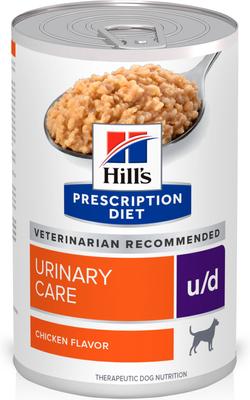
u/d Urinary Care Chicken Flavor Wet Dog Food, 13-oz, case of 12
Hill's Prescription Diet u/d Urinary Care Chicken Flavor Wet Dog Food, 13-oz, case of 12 earns a Sniff Score of 49/100 (C) with Limited evidence. Zero controversial ingredients flagged. Score capped at 49 due to CP_DM=2.2%, CF_DM=5.6%.
Graded by The Sniff System
AAFCO feeding trial substantiation for not stated.
Includes egg, named fish, or organ meat for diverse high-bioavailability protein.
Read why each ingredient is good or bad for dogs.
- 1water
Just water. Counted on the label of any wet or fresh food. The number tells you the moisture content.
- 2corn starch
- 3protein animalegg product
Processed whole eggs. Same nutritional profile as fresh eggs, just shelf-stable.
- 4fatchicken fat
Despite the name, a high-quality energy source. Concentrated calories plus essential fatty acids like linoleic acid.
- 5protein animalpork liver
Organ meat. Dense in B vitamins, iron, and vitamin A. Among the most nutritious ingredients on any label.
- 6sugar
Added sugar. No nutritional purpose for dogs. Most often found in budget semi-moist foods.
- 7grainrice
Generic rice. Could be white or brown, the label doesn't say. Brown rice would be specified if it were.
- 8fiberpowdered cellulose
Plant fiber, often from wood pulp. Cheap bulk filler. Not harmful, but a tell that the recipe is reaching for inexpensive bulk.
- 9fatflaxseed
Plant source of omega-3. Helpful for skin and coat, though dogs absorb omega-3 from fish more efficiently.
- 10mineralcalcium carbonate
Source of calcium. Functional. Required in complete dog foods, especially those without bone-in meat meals.
- 11potassium citrate
Source of potassium. Sometimes added in urinary-support formulas to help manage urine pH.
- 12mineralpotassium chloride
Required mineral. Sometimes used as a salt substitute. Standard inclusion in complete diets.
- 13monosodium phosphate
Mineral source and preservative. Standard inclusion at small doses.
- 14vitaminvitamin e supplement
Required nutrient and a natural antioxidant. Often pulls double duty as a preservative.
- 15vitaminthiamine mononitrate
B vitamin (B1). Essential for nervous system function. Cooked-in vitamin loss is why thiamine is always added back.
- 16vitaminpyridoxine hydrochloride
B vitamin (B6). Essential for protein metabolism. Standard inclusion in complete formulas.
- 17vitaminniacin supplement
B vitamin (B3). Required in complete dog foods, added as a supplement to standardize the dose.
- 18vitamincalcium pantothenate
Same as d-calcium pantothenate. Vitamin B5 in standardized form.
- 19vitaminvitamin b12 supplement
Essential for red blood cell formation and neurological function. Plant ingredients lack B12, so it has to be added.
- 20vitaminriboflavin supplement
B vitamin (B2). Required in complete dog foods. The standardized form ensures consistent dosing.
- 21vitaminbiotin
B vitamin that supports skin and coat health. Required for AAFCO-complete formulas.
- 22vitaminfolic acid
B vitamin (B9), essential for cell function. Standard in complete dog foods.
- 23vitaminvitamin d3 supplement
The active form of vitamin D dogs need. Required for calcium absorption and bone health.
- 24supplementl-lysine
Essential amino acid. Plant-protein-heavy formulas sometimes add it to round out the amino acid profile.
- 25supplementdl-methionine
Essential amino acid. Often added when plant proteins dominate, since methionine is naturally lower in pulses than meat.
Showing first 25 of 36. Position 1-5 has the largest weight in the recipe.
24 of 25 ingredients have a curated note. Coverage grows over time.