
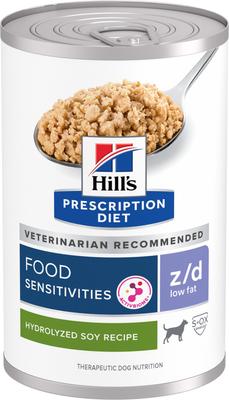
z/d Low Fat Hydrolyzed Soy Recipe Food Sensitivities Wet Dog Food, 13-oz can, case of 12
Hill's Prescription Diet z/d Low Fat Hydrolyzed Soy Recipe Food Sensitivities Wet Dog Food, 13-oz can, case of 12 earns a Sniff Score of 46/100 (C) with Limited evidence. Zero controversial ingredients flagged. Score capped at 49 due to CP_DM=6.1%, CF_DM=0.6%.
Graded by The Sniff System
Quality fat sources: named fat with marine oil (EPA and DHA source).
AAFCO feeding trial substantiation for not stated.
Controversial ingredients · 1
- sodium seleniteSynthetic selenium source. Selenium is essential, but sodium selenite has a narrower safety margin than organic alternatives like selenium yeast. Better-formulated foods use the organic form.
Every flagged ingredient has a published basis (confirmed harm / regulatory action / precautionary). See methodology →
Read why each ingredient is good or bad for dogs.
- 1water
Just water. Counted on the label of any wet or fresh food. The number tells you the moisture content.
- 2corn starch
- 3hydrolyzed soy protein
- 4soybean oil
Plant oil. High in omega-6, which is required but commonly oversupplied. Fine in moderation.
- 5mineraldicalcium phosphate
Calcium and phosphorus combined. Required source of both minerals, especially in formulas without much bone content.
- 6hydrolyzed chicken flavor
Hydrolyzed chicken used as a palatability enhancer. Real ingredient, tiny inclusion, no quality signal either way.
- 7ground pecan shells
- 8fatcoconut oil
Saturated fat with medium-chain triglycerides. Mostly marketing in the doses kibble uses, but harmless.
- 9mineralpotassium chloride
Required mineral. Sometimes used as a salt substitute. Standard inclusion in complete diets.
- 10fatflaxseed
Plant source of omega-3. Helpful for skin and coat, though dogs absorb omega-3 from fish more efficiently.
- 11fiberdried beet pulp
Soluble fiber from sugar-beet processing. Sometimes treated as a filler, but it's actually one of the better fiber sources in kibble.
- 12supplementcholine chloride
Essential nutrient for liver and brain function. Standard inclusion in complete dog foods.
- 13dried citrus pulp
- 14fatfish oil
Concentrated omega-3s. The reason 'EPA' and 'DHA' get to show up on the bag.
- 15pressed cranberries
- 16mineralmagnesium oxide
Inorganic magnesium. Functional at AAFCO doses, less efficiently absorbed than chelated forms.
- 17supplementtaurine
Amino acid critical for heart health. Especially important in grain-free or pulse-heavy formulas where natural taurine precursors run thin.
- 18monosodium phosphate
Mineral source and preservative. Standard inclusion at small doses.
- 19zinc oxide
Inorganic zinc. Cheapest mineral form on the market. Functional but less bioavailable than chelated alternatives.
- 20mineralferrous sulfate
Inorganic iron. Standard mineral source. Iron proteinate is the gentler, better-absorbed premium form.
- 21manganous oxide
Inorganic manganese. Functional, cheaper than chelated forms, less efficiently absorbed.
- 22mineralcopper sulfate
Inorganic copper. Standard, effective at small doses. Premium formulas tend to use copper proteinate instead.
- 23mineralcalcium iodate
Source of iodine for thyroid function. Functional, required in complete formulas.
- 24mineralsodium selenite Flagged
Inorganic selenium. Effective at AAFCO levels, no documented safety concern in dogs despite what some pet food blogs claim. Selenium yeast is a marginal upgrade, not a necessity. See why →
- 25supplementl-carnitine
Amino acid derivative that helps the body convert fat into energy. Common in weight-management formulas.
Showing first 25 of 26. Position 1-5 has the largest weight in the recipe.
20 of 25 ingredients have a curated note. Coverage grows over time.