
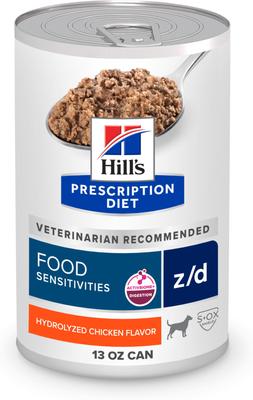
z/d Skin & Food Sensitivities Hydrolyzed Chicken Flavor Wet Dog Food, 13-oz can, case of 12
Hill's Prescription Diet z/d Skin & Food Sensitivities Hydrolyzed Chicken Flavor Wet Dog Food, 13-oz can, case of 12 earns a Sniff Score of 47/100 (C) with Fair evidence. Zero controversial ingredients flagged. Score capped at 49 due to CP_DM=13.6%, CF_DM=9.1%.
Graded by The Sniff System
Reasonable protein quality. hydrolyzed chicken liver delivers solid amino acid coverage.
Quality fat sources: named fat with marine oil (EPA and DHA source).
AAFCO feeding trial substantiation for not stated.
Wet and fresh foods contain more water than kibble (typically 65-78%). On a dry-matter basis, this food's protein content is roughly 14%, comparable to premium kibble (typically 30-45% DMB protein).
Read why each ingredient is good or bad for dogs.
- 1water
Just water. Counted on the label of any wet or fresh food. The number tells you the moisture content.
- 2hydrolyzed chicken liver
- 3corn starch
- 4ground pecan shells
- 5soybean oil
Plant oil. High in omega-6, which is required but commonly oversupplied. Fine in moderation.
- 6fatflaxseed
Plant source of omega-3. Helpful for skin and coat, though dogs absorb omega-3 from fish more efficiently.
- 7fiberdried beet pulp
Soluble fiber from sugar-beet processing. Sometimes treated as a filler, but it's actually one of the better fiber sources in kibble.
- 8dried citrus pulp
- 9fatfish oil
Concentrated omega-3s. The reason 'EPA' and 'DHA' get to show up on the bag.
- 10mineraldicalcium phosphate
Calcium and phosphorus combined. Required source of both minerals, especially in formulas without much bone content.
- 11fiberpowdered cellulose
Plant fiber, often from wood pulp. Cheap bulk filler. Not harmful, but a tell that the recipe is reaching for inexpensive bulk.
- 12fatcoconut oil
Saturated fat with medium-chain triglycerides. Mostly marketing in the doses kibble uses, but harmless.
- 13mineralcalcium carbonate
Source of calcium. Functional. Required in complete dog foods, especially those without bone-in meat meals.
- 14pressed cranberries
- 15mineralpotassium chloride
Required mineral. Sometimes used as a salt substitute. Standard inclusion in complete diets.
- 16supplementdl-methionine
Essential amino acid. Often added when plant proteins dominate, since methionine is naturally lower in pulses than meat.
- 17mineralsalt
Sodium chloride. Required at small doses for normal physiology. Not a quality concern in standard amounts.
- 18supplementcholine chloride
Essential nutrient for liver and brain function. Standard inclusion in complete dog foods.
- 19potassium citrate
Source of potassium. Sometimes added in urinary-support formulas to help manage urine pH.
- 20mineralferrous sulfate
Inorganic iron. Standard mineral source. Iron proteinate is the gentler, better-absorbed premium form.
- 21zinc oxide
Inorganic zinc. Cheapest mineral form on the market. Functional but less bioavailable than chelated alternatives.
- 22mineralcopper sulfate
Inorganic copper. Standard, effective at small doses. Premium formulas tend to use copper proteinate instead.
- 23mineralmanganese sulfate
Inorganic manganese. Functional but less well-absorbed than the chelated proteinate form.
- 24mineralcalcium iodate
Source of iodine for thyroid function. Functional, required in complete formulas.
- 25supplementl-tryptophan
Essential amino acid. Sometimes added in calming or weight-management formulas.
Showing first 25 of 28. Position 1-5 has the largest weight in the recipe.
20 of 25 ingredients have a curated note. Coverage grows over time.