
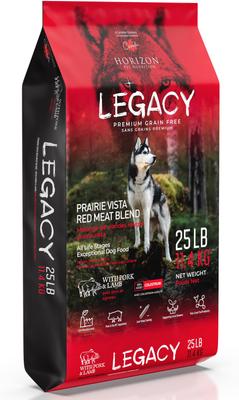
Legacy Prairie Vista Red Meat Blend Dog Dry Food, 25-lb bag
Horizon Legacy Prairie Vista Red Meat Blend Dog Dry Food, 25-lb bag earns a Sniff Score of 59/100 (C) with Fair evidence. 1 controversial ingredient flagged. Score capped at 59 due to no AAFCO statement.
Graded by The Sniff System
Strong protein profile with pork as the primary ingredient, delivering high biological value.
Quality fat sources: named fat with marine oil (EPA and DHA source).
Named fresh meat paired with same-species meal, a strong extrusion architecture.
No AAFCO statement. Nutritional completeness unverified.
Contains high legume stacking. Multiple pulse-family ingredients in top 15. Mitigated by taurine supplementation or organ meat (natural taurine precursor) in top 10..
Read why each ingredient is good or bad for dogs.
- 1protein animalpork
Real meat. Dense protein and fat, though less common in dog food than chicken or beef.
- 2protein animalpork meal
Pork cooked into a dry concentrate. Per pound, more protein than fresh pork.
- 3legumechickpeas
Also called garbanzo beans. Affordable plant protein source, part of the legume stack the FDA examined in its heart-disease investigation. See why →
- 4protein plantpea protein
Concentrated plant protein. Inflates the protein number on the label without matching the amino acid quality of meat.
- 5dried yeast
Natural source of B vitamins and trace minerals. Adds a savory flavor that dogs respond well to.
- 6legumepeas
Cheap protein bulk. Fine in small amounts, but when peas stack with lentils and chickpeas in the top ingredients, it's the pattern the FDA flagged in its heart-disease investigation. See why →
- 7pea starch
Refined starch from peas, mostly carbs after the protein is removed. Counts toward the legume stack the FDA examined.
- 8fatflaxseed
Plant source of omega-3. Helpful for skin and coat, though dogs absorb omega-3 from fish more efficiently.
- 9protein animallamb meal
Lamb cooked down to a dry concentrate. Per pound, more protein than fresh lamb.
- 10fatcanola oil
Plant oil. Some omega-3 from the parent plant, though dogs absorb it less efficiently than fish-derived omega-3. Fine in moderation.
- 11protein animalegg product
Processed whole eggs. Same nutritional profile as fresh eggs, just shelf-stable.
- 12fatsalmon oil
Pure omega-3s. The thing skin-and-coat formulas are usually built around.
- 13mineraldicalcium phosphate
Calcium and phosphorus combined. Required source of both minerals, especially in formulas without much bone content.
- 14mineralpotassium chloride
Required mineral. Sometimes used as a salt substitute. Standard inclusion in complete diets.
- 15vegetablecarrots
Real vegetable. Fiber, beta-carotene, and a small amount of antioxidant value.
- 16fruitapples
Real fruit, some fiber and antioxidants. The amount in kibble is too small to matter much.
- 17vegetablebroccoli
Real vegetable. Adds fiber and some antioxidants. Fine in the small amounts used in kibble.
- 18bok choy
- 19vegetablecabbage
- 20fruitblueberries
Antioxidants, real. But the amount in any kibble is too small to do much. Mostly marketing.
- 21mineralsalt
Sodium chloride. Required at small doses for normal physiology. Not a quality concern in standard amounts.
- 22hydrolyzed yeast
Yeast broken down with enzymes. Strong palatant plus a real source of B vitamins and amino acids.
- 23fiberfructooligosaccharides
Prebiotic fiber, often called FOS. Feeds beneficial gut bacteria, similar in function to inulin.
- 24supplementyucca schidigera extract
Plant extract added to reduce stool odor. Functional, not nutritional. Fine in trace amounts.
- 25supplementtaurine
Amino acid critical for heart health. Especially important in grain-free or pulse-heavy formulas where natural taurine precursors run thin.
Showing first 25 of 59. Position 1-5 has the largest weight in the recipe.
23 of 25 ingredients have a curated note. Coverage grows over time.