
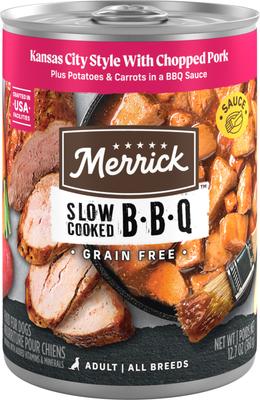
Grain-Free Wet Dog Food Slow-Cooked BBQ Kansas City Style with Chopped Pork, 12.7-oz can, case of 12
Merrick Grain-Free Wet Dog Food Slow-Cooked BBQ Kansas City Style with Chopped Pork, 12.7-oz can, case of 12 earns a Sniff Score of 59/100 (C) with Fair evidence. 2 controversial ingredients flagged. Primary concern: contains guar gum. emerging microbiome data on emulsifiers; no canine clinical evidence. minor penalty in canned food...
Graded by The Sniff System
Reasonable protein quality. pork delivers solid amino acid coverage.
Quality fat sources: named fat with marine oil (EPA and DHA source).
Quality carbohydrate sources with declared fiber.
Contains guar gum. Emerging microbiome data on emulsifiers; no canine clinical evidence. Minor penalty in canned food..
Contains added sugar. Nutritionally unjustifiable in any complete dog diet..
Controversial ingredients · 1
- sodium seleniteSynthetic selenium source. Selenium is essential, but sodium selenite has a narrower safety margin than organic alternatives like selenium yeast. Better-formulated foods use the organic form.
Every flagged ingredient has a published basis (confirmed harm / regulatory action / precautionary). See methodology →
Wet and fresh foods contain more water than kibble (typically 65-78%). On a dry-matter basis, this food's protein content is roughly 44%, comparable to premium kibble (typically 30-45% DMB protein).
Read why each ingredient is good or bad for dogs.
- 1protein animalpork
Real meat. Dense protein and fat, though less common in dog food than chicken or beef.
- 2beef broth
Real broth. Adds flavor and moisture, signals the recipe leans on real meat.
- 3vegetable broth
- 4protein animalpork liver
Organ meat. Dense in B vitamins, iron, and vitamin A. Among the most nutritious ingredients on any label.
- 5dried egg product
Whole eggs with the water removed. Same nutritional value as fresh eggs, just shelf-stable.
- 6vegetablepotato
Standard white potato. Steady carb source, common starch in grain-free recipes.
- 7vegetablecarrots
Real vegetable. Fiber, beta-carotene, and a small amount of antioxidant value.
- 8natural porcine flavor
- 9potato starch
Refined potato. Pure carb energy, low on other nutrition. Often used as a binder in grain-free recipes.
- 10fiberguar gum
Thickener common in wet food. Emerging research on emulsifiers and the gut microbiome, but no smoking gun in dogs yet.
- 11mineralcalcium carbonate
Source of calcium. Functional. Required in complete dog foods, especially those without bone-in meat meals.
- 12dried tomato
- 13mineralsalt
Sodium chloride. Required at small doses for normal physiology. Not a quality concern in standard amounts.
- 14fatsunflower oil
Common plant oil. Useful in moderation for omega-6, though too much skews the omega ratio against the dog's favor.
- 15fruit juice color
- 16sodium phosphate
Mineral source and preservative. Standard inclusion at small doses.
- 17mineralpotassium chloride
Required mineral. Sometimes used as a salt substitute. Standard inclusion in complete diets.
- 18cane molasses
Added sugar from sugar cane. Used for palatability or texture. Dogs don't need added sugar.
- 19fatfish oil
Concentrated omega-3s. The reason 'EPA' and 'DHA' get to show up on the bag.
- 20flaxseed oil
- 21natural smoke flavor
- 22mineralzinc proteinate
Zinc bound to protein for better absorption. The premium form of the mineral, versus zinc oxide which sits cheaper on the label.
- 23mineraliron proteinate
Iron bound to protein for better absorption. The premium form versus inorganic iron sulfate.
- 24mineralcopper proteinate
Copper bound to protein for better absorption. Common in better-formulated diets.
- 25cobalt proteinate
Cobalt bound to protein. Trace mineral needed for vitamin B12 synthesis, chelated form for better absorption.
Showing first 25 of 32. Position 1-5 has the largest weight in the recipe.
19 of 25 ingredients have a curated note. Coverage grows over time.