
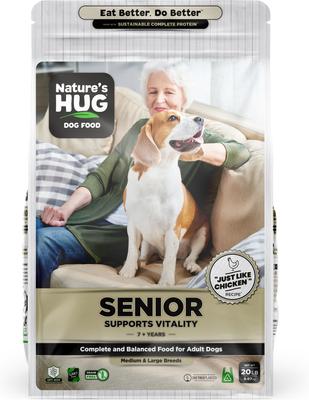
Non-GMO Grain-Free Supports Vitality Senior Medium & Large Breed Dry Dog Food, 20-lb bag
Nature's HUG Non-GMO Grain-Free Supports Vitality Senior Medium & Large Breed Dry Dog Food, 20-lb bag earns a Sniff Score of 32/100 (D) with Fair evidence. 2 controversial ingredients flagged. Primary concern: low protein quality. dried yeast delivers limited bioavailable amino acids..
Graded by The Sniff System
AAFCO formulation inferred from declared adult maintenance. Verbatim statement not published by retailer.
Low protein quality. dried yeast delivers limited bioavailable amino acids.
Contains msg. Safety signal is internet-fueled; real issue is transparency. Yeast extract as MSG loophole obscures formulation..
Contains high legume stacking. Multiple pulse-family ingredients in top 15. Mitigated by taurine supplementation or organ meat (natural taurine precursor) in top 10..
Controversial ingredients · 1
- sodium seleniteSynthetic selenium source. Selenium is essential, but sodium selenite has a narrower safety margin than organic alternatives like selenium yeast. Better-formulated foods use the organic form.
Every flagged ingredient has a published basis (confirmed harm / regulatory action / precautionary). See methodology →
Read why each ingredient is good or bad for dogs.
- 1dried yeast
Natural source of B vitamins and trace minerals. Adds a savory flavor that dogs respond well to.
- 2legumegreen peas
Same as peas. Useful in small amounts. The concern is when pulses dominate the top of the ingredient list. See why →
- 3legumelentils
Same concern as peas. Affordable plant protein, but when they pile up in the top 5 ingredients, it's a flag. See why →
- 4legumechickpeas
Also called garbanzo beans. Affordable plant protein source, part of the legume stack the FDA examined in its heart-disease investigation. See why →
- 5legumenavy beans
- 6fatcanola oil
Plant oil. Some omega-3 from the parent plant, though dogs absorb it less efficiently than fish-derived omega-3. Fine in moderation.
- 7flaxseeds
Plural form, same as flaxseed. Plant source of omega-3, helpful for skin and coat.
- 8fatsunflower oil
Common plant oil. Useful in moderation for omega-6, though too much skews the omega ratio against the dog's favor.
- 9monocalcium phosphate
Source of calcium and phosphorus. Standard mineral inclusion in complete dog foods.
- 10carrot
Real vegetable. Fiber, beta-carotene, antioxidants. Same as carrots, sometimes singular on labels.
- 11mineralcalcium carbonate
Source of calcium. Functional. Required in complete dog foods, especially those without bone-in meat meals.
- 12sesame seeds
- 13apple pomace
- 14suncured alfalfa meal
Sun-dried alfalfa, preserving more of the natural vitamins than heat-dried versions.
- 15protein plantpea protein
Concentrated plant protein. Inflates the protein number on the label without matching the amino acid quality of meat.
- 16othernatural flavor
Legal term for animal-derived flavoring, usually hydrolyzed liver or broth. Adds taste, says nothing about quality.
- 17yeast culture
Fermented yeast. Source of B vitamins and beta-glucans that some research suggests support immune function.
- 18mineralsalt
Sodium chloride. Required at small doses for normal physiology. Not a quality concern in standard amounts.
- 19supplementcholine chloride
Essential nutrient for liver and brain function. Standard inclusion in complete dog foods.
- 20lecithin
Natural emulsifier, usually from soy or sunflower. Helps blend fats and water. Safe at typical inclusion.
- 21supplementdl-methionine
Essential amino acid. Often added when plant proteins dominate, since methionine is naturally lower in pulses than meat.
- 22supplementtaurine
Amino acid critical for heart health. Especially important in grain-free or pulse-heavy formulas where natural taurine precursors run thin.
- 23mineralpotassium chloride
Required mineral. Sometimes used as a salt substitute. Standard inclusion in complete diets.
- 24mineralferrous sulfate
Inorganic iron. Standard mineral source. Iron proteinate is the gentler, better-absorbed premium form.
- 25zinc oxide
Inorganic zinc. Cheapest mineral form on the market. Functional but less bioavailable than chelated alternatives.
Showing first 25 of 63. Position 1-5 has the largest weight in the recipe.
22 of 25 ingredients have a curated note. Coverage grows over time.