
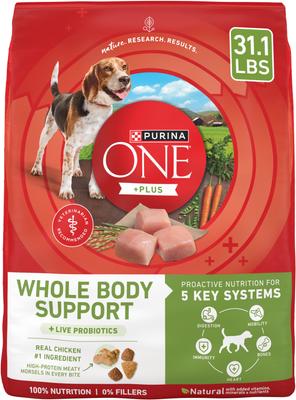
Whole Body Support Chicken Dry Dog Food, 31.1-lb. bag
Purina ONE Whole Body Support Chicken Dry Dog Food, 31.1-lb. bag earns a Sniff Score of 55/100 (C) with Fair evidence. Zero controversial ingredients flagged. Score capped at 59 due to no AAFCO statement.
Graded by The Sniff System
Reasonable protein quality. chicken delivers solid amino acid coverage.
Quality fat sources: named fat with marine oil (EPA and DHA source).
No AAFCO statement. Nutritional completeness unverified.
Controversial ingredients · 1
- sodium seleniteSynthetic selenium source. Selenium is essential, but sodium selenite has a narrower safety margin than organic alternatives like selenium yeast. Better-formulated foods use the organic form.
Every flagged ingredient has a published basis (confirmed harm / regulatory action / precautionary). See methodology →
Read why each ingredient is good or bad for dogs.
- 1protein animalchicken
Real meat. Primary protein source, with the amino acid profile dogs actually evolved to eat.
- 2grainrice
Generic rice. Could be white or brown, the label doesn't say. Brown rice would be specified if it were.
- 3protein animalchicken by-product meal
Ground organs, bone, and tissue. Nutritionally dense, especially the liver and gizzard fractions. Named species ('chicken') is what matters. Generic 'poultry by-product meal' is the one to worry about.
- 4corn protein meal
Concentrated corn protein. Similar in role to corn gluten meal, pads the protein number on the label without matching meat amino acids.
- 5grainwheat
Whole wheat. Fine for most dogs, though a portion are sensitive. Not a quality concern, just a fit-for-your-dog question.
- 6animal fat preserved with mixed tocopherols
- 7protein plantsoybean meal
Concentrated soy protein. Cheap plant protein that pads the label number, common in budget formulas.
- 8oat meal
Alternate spelling of oatmeal. Gentle whole grain, steady carb energy, soluble fiber.
- 9grainwhole grain corn
Whole corn with the kernel intact. Decent fiber and B vitamins, though it can crowd out meat in cheaper recipes.
- 10fatfish oil
Concentrated omega-3s. The reason 'EPA' and 'DHA' get to show up on the bag.
- 11othernatural flavor
Legal term for animal-derived flavoring, usually hydrolyzed liver or broth. Adds taste, says nothing about quality.
- 12glycerin
Humectant used in soft-moist foods to keep them chewy. Safe in moderation but a signal of a processed semi-moist product.
- 13mineralcalcium carbonate
Source of calcium. Functional. Required in complete dog foods, especially those without bone-in meat meals.
- 14mono and dicalcium phosphate
Source of calcium and phosphorus. Standard inclusion in complete dog foods.
- 15mineralsalt
Sodium chloride. Required at small doses for normal physiology. Not a quality concern in standard amounts.
- 16mineralpotassium chloride
Required mineral. Sometimes used as a salt substitute. Standard inclusion in complete diets.
- 17vegetablecarrots
Real vegetable. Fiber, beta-carotene, and a small amount of antioxidant value.
- 18legumepeas
Cheap protein bulk. Fine in small amounts, but when peas stack with lentils and chickpeas in the top ingredients, it's the pattern the FDA flagged in its heart-disease investigation. See why →
- 19supplementcholine chloride
Essential nutrient for liver and brain function. Standard inclusion in complete dog foods.
- 20vegetable juice
- 21mineralzinc sulfate
Inorganic zinc. Effective at AAFCO doses but less well-absorbed than chelated forms like zinc proteinate.
- 22mineralferrous sulfate
Inorganic iron. Standard mineral source. Iron proteinate is the gentler, better-absorbed premium form.
- 23mineralmanganese sulfate
Inorganic manganese. Functional but less well-absorbed than the chelated proteinate form.
- 24mineralcopper sulfate
Inorganic copper. Standard, effective at small doses. Premium formulas tend to use copper proteinate instead.
- 25mineralcalcium iodate
Source of iodine for thyroid function. Functional, required in complete formulas.
Showing first 25 of 30. Position 1-5 has the largest weight in the recipe.
23 of 25 ingredients have a curated note. Coverage grows over time.