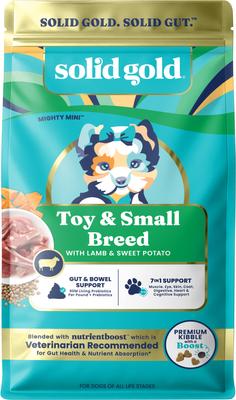
NutrientBoost Lamb & Sweet Potato Toy & Small Breed Gut Health Grain-Free Dry Dog Food, 11-lb bag
Solid Gold NutrientBoost Lamb & Sweet Potato Toy & Small Breed Gut Health Grain-Free Dry Dog Food, 11-lb bag earns a Sniff Score of 56/100 (C) with Fair evidence. 1 controversial ingredient flagged. Score capped at 59 due to no AAFCO statement.
Graded by The Sniff System
Reasonable protein quality. lamb delivers solid amino acid coverage.
Quality fat sources: named fat with marine oil (EPA and DHA source).
Named fresh meat paired with same-species meal, a strong extrusion architecture.
No AAFCO statement. Nutritional completeness unverified.
Contains high legume stacking. Multiple pulse-family ingredients in top 15. Mitigated by taurine supplementation or organ meat (natural taurine precursor) in top 10..
Controversial ingredients · 1
- sodium seleniteSynthetic selenium source. Selenium is essential, but sodium selenite has a narrower safety margin than organic alternatives like selenium yeast. Better-formulated foods use the organic form.
Every flagged ingredient has a published basis (confirmed harm / regulatory action / precautionary). See methodology →
Read why each ingredient is good or bad for dogs.
- 1protein animallamb
Real meat. Often used for dogs with chicken or beef sensitivities. Slightly higher fat content than chicken.
- 2protein animallamb meal
Lamb cooked down to a dry concentrate. Per pound, more protein than fresh lamb.
- 3protein animalocean fish meal
- 4legumechickpeas
Also called garbanzo beans. Affordable plant protein source, part of the legume stack the FDA examined in its heart-disease investigation. See why →
- 5legumepeas
Cheap protein bulk. Fine in small amounts, but when peas stack with lentils and chickpeas in the top ingredients, it's the pattern the FDA flagged in its heart-disease investigation. See why →
- 6vegetablesweet potato
Complex carb with fiber and beta-carotene. Gentle on the stomach.
- 7protein plantpea protein
Concentrated plant protein. Inflates the protein number on the label without matching the amino acid quality of meat.
- 8fatchicken fat
Despite the name, a high-quality energy source. Concentrated calories plus essential fatty acids like linoleic acid.
- 9legumelentils
Same concern as peas. Affordable plant protein, but when they pile up in the top 5 ingredients, it's a flag. See why →
- 10fatground flaxseed
Cracked flaxseed for better digestibility. Same plant omega-3s as whole flaxseed, just easier for the dog to extract.
- 11animal plasma
- 12vegetablecarrots
Real vegetable. Fiber, beta-carotene, and a small amount of antioxidant value.
- 13othernatural flavor
Legal term for animal-derived flavoring, usually hydrolyzed liver or broth. Adds taste, says nothing about quality.
- 14spray dried animal blood cells
- 15mineralsalt
Sodium chloride. Required at small doses for normal physiology. Not a quality concern in standard amounts.
- 16fatsalmon oil
Pure omega-3s. The thing skin-and-coat formulas are usually built around.
- 17l-threonine
Essential amino acid. Sometimes added when plant proteins dominate, since threonine is naturally lower in plants than meat.
- 18vegetablepumpkin
Soluble fiber that supports stool quality. Mild and well-tolerated.
- 19fruitblueberries
Antioxidants, real. But the amount in any kibble is too small to do much. Mostly marketing.
- 20fruitcranberries
Often added with a urinary-tract-support marketing angle. Real cranberry compounds help in concentrate form, but kibble doses are small.
- 21supplementdl-methionine
Essential amino acid. Often added when plant proteins dominate, since methionine is naturally lower in pulses than meat.
- 22mineralzinc sulfate
Inorganic zinc. Effective at AAFCO doses but less well-absorbed than chelated forms like zinc proteinate.
- 23mineralferrous sulfate
Inorganic iron. Standard mineral source. Iron proteinate is the gentler, better-absorbed premium form.
- 24mineralcopper sulfate
Inorganic copper. Standard, effective at small doses. Premium formulas tend to use copper proteinate instead.
- 25mineralmanganese sulfate
Inorganic manganese. Functional but less well-absorbed than the chelated proteinate form.
Showing first 25 of 35. Position 1-5 has the largest weight in the recipe.
22 of 25 ingredients have a curated note. Coverage grows over time.