
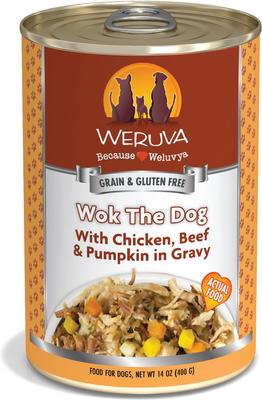
Wok the Dog with Chicken, Beef & Pumpkin in Gravy Grain-Free Canned Dog Food, 14-oz, case of 12
Weruva Wok the Dog with Chicken, Beef & Pumpkin in Gravy Grain-Free Canned Dog Food, 14-oz, case of 12 earns a Sniff Score of 48/100 (C) with Fair evidence. 1 controversial ingredient flagged. Score capped at 59 due to no AAFCO statement.
Graded by The Sniff System
Quality carbohydrate sources with fermentable fiber.
No declared omega-3 source. Fish oil, salmon oil, and algae oil all absent.
No AAFCO statement. Nutritional completeness unverified.
Wet and fresh foods contain more water than kibble (typically 65-78%). On a dry-matter basis, this food's protein content is roughly 53%, comparable to premium kibble (typically 30-45% DMB protein).
Read why each ingredient is good or bad for dogs.
- 1protein animalchicken
Real meat. Primary protein source, with the amino acid profile dogs actually evolved to eat.
- 2protein animalbeef
Real meat. Dense in protein and iron. Some dogs are sensitive to it, but for most it's an excellent base.
- 3water sufficient for processing
The regulatory phrase for cooking water in wet food. Has no nutritional implication, just labeling formality.
- 4vegetablepumpkin
Soluble fiber that supports stool quality. Mild and well-tolerated.
- 5carrot
Real vegetable. Fiber, beta-carotene, antioxidants. Same as carrots, sometimes singular on labels.
- 6vegetablesweet potato
Complex carb with fiber and beta-carotene. Gentle on the stomach.
- 7potato starch
Refined potato. Pure carb energy, low on other nutrition. Often used as a binder in grain-free recipes.
- 8sunflower seed oil
- 9mineraldicalcium phosphate
Calcium and phosphorus combined. Required source of both minerals, especially in formulas without much bone content.
- 10fiberxanthan gum
Thickener common in wet food and gravies. Same emulsifier-microbiome conversation as guar gum, not a clear flag.
- 11dried spinach
Leafy green. Some iron, vitamin K, and fiber. The dose in kibble is small but it's real food.
- 12supplementcholine chloride
Essential nutrient for liver and brain function. Standard inclusion in complete dog foods.
- 13mineralzinc sulfate
Inorganic zinc. Effective at AAFCO doses but less well-absorbed than chelated forms like zinc proteinate.
- 14vitaminvitamin e supplement
Required nutrient and a natural antioxidant. Often pulls double duty as a preservative.
- 15vitaminthiamine mononitrate
B vitamin (B1). Essential for nervous system function. Cooked-in vitamin loss is why thiamine is always added back.
- 16nicotinic acid
- 17mineralferrous sulfate
Inorganic iron. Standard mineral source. Iron proteinate is the gentler, better-absorbed premium form.
- 18vitamincalcium pantothenate
Same as d-calcium pantothenate. Vitamin B5 in standardized form.
- 19vitaminvitamin a supplement
Vitamin A in stable, standardized form. Required for vision, immune function, and growth.
- 20mineralpotassium iodide
Source of iodine, an essential trace mineral for thyroid function. Required for AAFCO-complete formulas.
- 21mineralmanganese sulfate
Inorganic manganese. Functional but less well-absorbed than the chelated proteinate form.
- 22vitaminvitamin d3 supplement
The active form of vitamin D dogs need. Required for calcium absorption and bone health.
- 23mineralcopper sulfate
Inorganic copper. Standard, effective at small doses. Premium formulas tend to use copper proteinate instead.
- 24vitaminriboflavin supplement
B vitamin (B2). Required in complete dog foods. The standardized form ensures consistent dosing.
- 25vitaminpyridoxine hydrochloride
B vitamin (B6). Essential for protein metabolism. Standard inclusion in complete formulas.
Showing first 25 of 27. Position 1-5 has the largest weight in the recipe.
23 of 25 ingredients have a curated note. Coverage grows over time.