
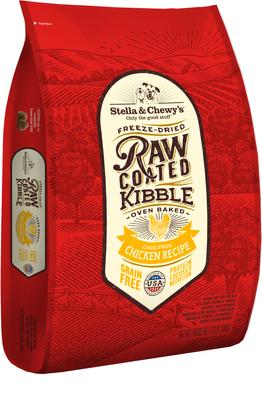
Cage-Free Chicken Raw Coated Kibble for Small Breed Dogs
Stella & Chewy's Cage-Free Chicken Raw Coated Kibble for Small Breed Dogs earns a Sniff Score of 73/100 (B) with Fair evidence. Zero controversial ingredients flagged. Strong protein profile with chicken as the primary ingredient, delivering high biological value..
Graded by The Sniff System
Strong protein profile with chicken as the primary ingredient, delivering high biological value.
Quality fat sources: named fat with marine oil (EPA and DHA source).
Named fresh meat paired with same-species meal, a strong extrusion architecture.
Controversial ingredients · 1
- sodium seleniteSynthetic selenium source. Selenium is essential, but sodium selenite has a narrower safety margin than organic alternatives like selenium yeast. Better-formulated foods use the organic form.
Every flagged ingredient has a published basis (confirmed harm / regulatory action / precautionary). See methodology →
Read why each ingredient is good or bad for dogs.
- 1protein animalchicken
Real meat. Primary protein source, with the amino acid profile dogs actually evolved to eat.
- 2protein animalchicken meal
Chicken with the water cooked out. Per pound, packs more protein than fresh chicken.
- 3legumepeas
Cheap protein bulk. Fine in small amounts, but when peas stack with lentils and chickpeas in the top ingredients, it's the pattern the FDA flagged in its heart-disease investigation. See why →
- 4legumelentils
Same concern as peas. Affordable plant protein, but when they pile up in the top 5 ingredients, it's a flag. See why →
- 5fatchicken fat
Despite the name, a high-quality energy source. Concentrated calories plus essential fatty acids like linoleic acid.
- 6fibertomato pomace
The fiber-rich byproduct of tomato processing. Sometimes flagged unfairly. It's a real fiber source, not a filler shortcut.
- 7othernatural flavor
Legal term for animal-derived flavoring, usually hydrolyzed liver or broth. Adds taste, says nothing about quality.
- 8fatflaxseed
Plant source of omega-3. Helpful for skin and coat, though dogs absorb omega-3 from fish more efficiently.
- 9fatsalmon oil
Pure omega-3s. The thing skin-and-coat formulas are usually built around.
- 10protein animalchicken liver
Organ meat. Dense in protein, iron, vitamin A, and the B vitamins. Among the most nutrient-rich ingredients a dog can eat.
- 11suncured alfalfa
- 12protein animalchicken gizzard
- 13chicken cartilage
- 14fenugreek seed
Herb seed. Trace inclusion, mostly for flavor and label appeal.
- 15vegetablepumpkin
Soluble fiber that supports stool quality. Mild and well-tolerated.
- 16coconut flour
- 17pumpkin seed
Real seed. Source of magnesium, zinc, and traditionally used as a mild dewormer (the evidence is folkloric, not clinical).
- 18fruitcranberries
Often added with a urinary-tract-support marketing angle. Real cranberry compounds help in concentrate form, but kibble doses are small.
- 19vegetablespinach
Leafy green. Some iron, vitamin K, and fiber. The dose in kibble is small but it's real food.
- 20vegetablebroccoli
Real vegetable. Adds fiber and some antioxidants. Fine in the small amounts used in kibble.
- 21beets
Whole beets, not to be confused with beet pulp. Real vegetable, fiber and antioxidants.
- 22vegetablecarrots
Real vegetable. Fiber, beta-carotene, and a small amount of antioxidant value.
- 23squash
Real vegetable. Fiber, vitamin A, gentle on the stomach. Similar nutrition role to sweet potato.
- 24fruitblueberries
Antioxidants, real. But the amount in any kibble is too small to do much. Mostly marketing.
- 25fiberinulin
Prebiotic fiber that feeds beneficial gut bacteria. Same compound found in chicory root.
Showing first 25 of 55. Position 1-5 has the largest weight in the recipe.
21 of 25 ingredients have a curated note. Coverage grows over time.